GIS INTRODUCTION AND ITS FUNCTIONAL SUBSYSTEMS


INTRODUCTION

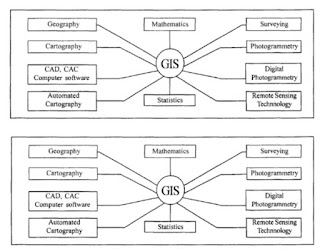
GIS (Geographic Information System) is a computer based tool used to store and operate geographic information. It deals with mapping and analyzing things happening on earth. GIS is known for explaining events, predicting results an planning strategies and that is why it is found different from other information systems and valuable to public and private enterprises.

GIS aim is management, analysis and visualization/ mapping of spatial data. The definition of GIS quoted by Burrough is:

"GIS is a powerful set of tools for collecting, storing, retrieving at will, transform and displaying spatial data from the real world."

GIS APPLICATIONS

GIS has the potential to be used in various fields. The problems faced by world today are overpopulation, pollution, deforestation, natural disasters. These challenges have critical geographic perspective.
GIS is used while selection of suitable site for business, finding best soil to grow crops, finding the best route for emergency vehicles. GIS is used to build maps, gather information, visualize scenarios, solve complex problems, present useful ideas and effective solutions for problems. GIS performs tasks better than manual methods.

FUNCTIONAL SUBSYSTEMS

A GIS has four functional subsystems. They are as follows:
  • Data Input Subsystem
  • Dta storage and retrieval subsystem
  • Data manipulation and analysis subsystem
  • Output/display subsystem
DATA INPUT

Data input deals with collecting, capturing and transforming the spatial and thematic data into digital form. Data input comes from aerial photographs, hard copy maps, remotely sensed images, reports, surveys, documents etc.

DATA STORAGE AND RETRIEVAL SUBSYSTEM
This subsystems organize the spatial and attribute data in a form the allows the users to retrieve this data quickly for analysis and allows correct updates to be done in database.

DATA MANIPULATION AND ANALYSIS SUBSYSTEM

This subsystem permits the user to define and implement spatial and attribute procedures to produce derived information. This subsystem is considered as heart of GIS.

OUTPUT/DISPLAY SUBSYSTEM

This subsystem allows graphic display, maps generation and tabular reports that show derived information products.


WORLD SUMMIT ON SUSTAINABLE DEVELOPMENT & WEHAB DISCUSSIONS


World Summit on Sustainable Development was held in Johannesburg in 2002. Summit should provide benefit to youth, children and vulnerable community. For sustainable development good governance is necessary in each country at international level.
Peace, security, stability, respect for human rights, fundamental freedom are all necessary for sustainable development.

SECTIONS
   
  • Introduction
  • Poverty Eradication
  • Changing unsustainable to sustainable patterns
  • Protecting and managing natural resources
  • Sustainable Development in Globalizing World
  • Health and Sustainable Development
  • Sustainable Development of Small Islands

Partnership Plenary Sessions
WEHAB DISCUSSIONS
SUMMARY

The WEHAB discussions were carried out in plenary in response to decision at prepcom IV. Five key sessions were discussed in WEHAB discussions by UN Secretary General Kofi Annan (contributor in World Summit on Sustainable Development): Water, Energy, Health, Agriculture and Biodiversity.

WEHAB SESSIONS

Health

Good health is essential for poverty eradication and sustainable development. Health is not all about reducing illness but it also deal with human rights to clean water, sanitation, quality and better health services. People who are poor are more at risk of illness and people who are ill are more likely to be poor. Health and Environment link should be given recognition. Health issues must be addressed by Health ministries and health sectors.
Most speakers agreed on following actions that must be held to address health issues:
  • Eradicate communicable diseases such as AIDS/ HIV , malaria, tuberculosis.
  • Treatment of common diseases such as diarrhea and respiratory diseases from pollution
  • Prevent and treat occupational health diseases and accidents
  • Improve access to sanitation and clean water
  • protection of health of vulnerable population
  • Gender Empowerment
Many speakers identified the need of following issues for achieving success in health issues:
  • Strong political will and long term commitment
  • Effective politics and strategies
  • Practical programmes on ground with clear targets
  • Partnership based on scientific knowledge, research and useful information
Participants identified the need of capacity building and research for:
  • assessing and managing health risks
  • planing and managing health needs
  • training good health care providers
Other discussions were:
  • learning from past lessons and best practices
  • committing global funding for HIV/AIDS, malaria and tuberculosis 
  • more resources for health of children
  • developing international code of conduct fro health personnel
Biodiversity

About 40 % of global economy depends upon biological products and processes. The economical value o biodiversity is found to be $ 2.9 trillion/year while economic services value is $3.3 trillion/year.
The threats on biological biodiversity by humans should be given attention. The biodiversity and poverty linkage should be given priority as poor people depends on biodiversity for their survival.
Challenge to biodiversity are:
  • ensuring equal benefits from the use of biodiversity
  • improving the knowledge of public about the importance of biodiversity
  • recognition of cultural and spiritual values of biodiversity
  • addressing need of paradigm shift
  • special conservation for the biodiversity areas and weak ecosystems
To address these challenges the participants pointed out following suggestions:
  • Better process and mechanism for strong action and implementation
  • use economic instruments in relation to biodiversity
  • build biodiversity related conventions
  • sharing more global and regional research
  • build capacities and technology sharing
  • address issues of Intellectual Property Rights
Agriculture

The key issues of agriculture in developing countries were:
  • Soil fertility problem in Sub Sahara Africa developing countries
  • need to increase water productivity
  • enhanced use of diverse crops, non farming practices as a source employment in rural areas
  • need to involve farmers in policy and decision making
  • addressing land tenure and land rights issues
  • providing financial incentives in key areas
  • strengthening warning practice against natural disasters
  • preventive actions to reduce hunger and enhance agriculture productivity
The need to address these issues were discussed by participants as:
  • Increase technological improvements (renewable technology, safe use of biotechnology)
  • increase public investment in agriculture and build markets
  • develop products that are marketable and promote market supplies
Special consideration in term of human resources should be given to:
  • Empowerment of women in order to reduce hunger 
  • Retaining youth in agriculture
  • identifying the needs of waged agricultural works and conditions
  • empowerment of local communities
Water and Sanitation

The issues in water and sanitation are as follows:

1.Access and availability
  • need of access of safe and quality water and sanitation to poor rural areas or in marginal urban areas
  • need of policies to pay for the services of poor population
  • need of decentralized solutions for meeting the needs of poor by less costly technologies
Allocation Issues
  • Integrated water resource managment should be promoted
  • Agriculture use highest water share there is the need to improve water use efficiency
  • Populations cannot pay for the services. The poor community should be taken into account in this perspective.
Capacity Building and technology need
  • need to introduce and maintain the technologies for poor
  • need of capacity building and education in water management and sanitation
  • education, information and public awareness is necessary

Energy

The issues in energy sector discussed were:
  • need of energy efficiency and conservation
  • importance of energy and health link
  • importance of clean energy sources
  • countries ability to take their own decisions in energy policies
  • need to restructure markets
  • need of safety nets for workers
Energy objectives discussed in discussion are:
  • Energy for poverty alleviation
  • Energy conservation and energy efficiency
  • Promotion of renewable energy
  • use of policies and economic instruments
  • meeting the needs of women
  • actions on climate change


CONCEPT OF GOVERNANCE AND GOOD GOVERNANCE IN ENVIRONMENT


GOVERNANCE


"Governance means a process of decision making and a process of implementation of these decisions."

Governance can be termed in different concepts such as International governance, Local governance, National governance and corporate governance. Both Formal and Informal actors are involved in decision making and in the process by which decisions are implemented. Formal and Informal structures are also set in place to make decision and to implement them.

Government is one of the actor in governance. In rural areas the actors involved other than government are: land lords, cooperatives, associations of peasant farmers, NGOs, research institutes, political leaders, religious leaders, finance institutes and military etc.  In urban areas the situation is more complex. Here in addition to above actors in rural areas at national level media lobbyists, international donors and multi national corporation are included. 

All actors other than government and military make a civil society. In some countries organized crime syndicates also perform decision making. In informal decision making Kitchen Cabinets or informal advisers also do decision making. In rural areas powerful local families affect decision making.

GOOD GOVERNANCE

Good governance ensures the minimization of corruption, hearing of minorities views, voices of vulnerable in society are heared.

CHARACTERISTICS OF GOOD GOVERNANCE

1. PARTICIPATION

Participation should involve both men and women in decision making. I should be organized and informed. participation could be direct or through intermediate institution.

2. RULE OF LAW

Good Governance require legal frameworks to be enforced. For the enforcement of laws independent judiciary, incorruptible police force are required.  Good governance need to protect the human rights.

3. TRANSPARENCY

Transparency means that decision taken and their enforcement should be in a way that follows rules and regulations. It also reflects that information is easily available to the people that are mostly affected by decision making. Information should be in understandable form.

4. RESPONSIVENESS

In good governance institutions and processes should serve all stakeholders within time frame.

5. CONSENSUS ORIENTED

Good governance requires what is needed for sustainable human development, what is best interest for the community. This results in understanding of historical, cultural and social perspective of society. 

6. EQUITY AND INCLUSIVENESS

All members should consider they have stake in it and they are not separate from the main society. 

7. EFFECTIVENESS AND EFFICIENCY

The efficiency in term of good governance deals with sustainable use of natural resources. Institutions produce best results to meet the needs of human society.

8. ACCOUNTABILITY

Government institutions, private sector and civil society organizations must be accountable to public and institutional stakeholders.


EX- SITU CONSERVATION STRATEGIES


Broadly the conservation strategies are divide into two types . They are:

  • On Site Preservation
  • Off Site or Ex Situ preservation
On Situ Preservation

The best strategy to conserve species is to preserve them in wild in their natural communities. This is known as π or On site preservation. Natural communities are evolutionary adapted to the changing environment. In the wild species genetic variability is not lost by genetic drift. But on site preservation is not suitable for many rare and endangered species. They go extinct due to many reasons ass described in earlier posts. These are: genetic erosion, deteriorating habitat, changes in environment, competition from exotic species, disease and excessive hunting.

Ex Situ or Off-Site Preservation

When the remaining population is too small or when the individuals are found outside the protected area than on site preservation may not be effective. Than the species are preserved in an artificial condition under human supervision. This strategy is known as off site or ex situ preservation. A number of species that have extinct are already grown in captivity e.g. Elaphurus Davidianus and Equus caballus przewalski. 

Ex Situ Facilities for animal preservation are:
  • Zoos
  • Game Farms
  • Aquaria
  • Private Breeders
Ex Situ Facilities for plants preservation are:
  • Botanical Gardens
  • Arboreta
  • Seed Banks
The strategy that combines these two strategies is the protection of rare and endangered species in small protected areas. The species are somewhat wild but human intervention is necessary there to prevent loss of species.
Long term ex situ conservation reduce the need of research and display of wild collected individuals. In situ preservation is necessary for the conservation of those species that are difficult to raise in captivity or in zoos or botanical gardens.

Ex Situ Conservation Limitations in Comparison with In Situ Preservation

1. Population Size

To prevent genetic drift several hundreds of populations need to be maintained in ex situ preservation. No zoo can preserve such large quantity of animals and only few animal species could be kept in captivity. In botanical garden one or few individuals of species could be maintained.

2. Adaptation

Ex situ populations may have genetic adaptations when kept in captivity for several generations due to changes in their mouth parts and digestive systems by the food of zoo. When these animals are returned to wild they might not adapt to eat their natural food in wild.

3. Learning Skills

Learning skills could not be develop in to captive bred individuals. When they are returned to wild they are not able to find their food, they can not judge their predators and not know how to compete with them. The problem is worse in social animals in juveniles who learn from their parent members in their group. 

4. Genetic Variability

Ex situ conserved species have limited gene pool. The species collected from warm low land areas for captivity may not be able to adapt for cold in cold high land areas.

5. Continuity

This conservation needs continuous supply of funds and institutional policy. Frozen, chilled collection of sperms, eggs, seeds and tissues are affected by loss of electric power. 

6. Concentration

Ex situ efforts are done at smaller places. There is a danger to the entire population when any disaster come.

7. Surplus Animals

Surplus animals could not be kept in captivity. In zoo only few species can be bred. 


ESTABLISHMENT OF NEW PLANT POPULATIONS


Methods to establish new plant populations are different from establishing vertebrate or animal populations. Animals can move from one place to another in search of food or moisture conditions. In plants the seeds are dispersed to the other sites through wind, water and animals or by conservation biologists activity.
When a seed is planted on a site it is unable to move even if a suitable site exists at few meters distance. The immediate small suitable site is necessary in case when environmental conditions become harsh e.g. the weather is too hot, too wet, too dry or too shady. In these conditions the seeds either don't germinate or plants die. Plants are vulnerable to attacks by insects, pests and fungi. Fire also disturb the seeds establishment.

Considerations while reintroduction of Plants
  • Careful site selection should be taken into account otherwise plants will not be able to survive or flower.
  • Those factors should be identified that cause the decline in plants species.
  • Management techniques should be developed to manage the introduce and native species.
Some plant populations fail to establish when seeds are planted at the sites even sites were found suitable for them. In a case seeds of 6 annual plants species were planted in 48 suitable sites. After 2 years the plant population persisted on 5 sites and after 6 years population persisted on only 1 site. At these successful sites the population size of species of plants increased to 10,000 and it spread to 30 m around margins of marshy pond.
In another case seeds of 35 perennial herbs species were sown at 173 sites. No seedling was observed at 167 sites out of 173 sites. No individuals were seen at 32 out of 35 species.

The problem arise while sowing the seeds is that the species did not mimic the natural process exactly. To overcome these problems new techniques were introduced such as:
  • Fencing to exclude animals
  • Removal of existing vegetation
  • Plant nurse plants in arid regions
  • Adding mineral nutrients

Keys to Success

The keys to success are as follows:
  • using as many sites as possible
  • use as many seeds and adult plants as possible
  • reintroducing species year after year at many sites
  • careful monitoring of seedlings and adults
Case Study

The large flowered fiddleneck is an annual plant belonging from northern California. It has not a wide range. These species decline due to livestock grazing and fire suppression. Reintroduction of these fiddleneck was done with careful considerations such as management of grass specific herbicides and burning. This was first implemented in experiment than it was applied to natural population resulting in increase in plant population.


CONSIDERATIONS FOR SUCCESSFUL PROGRAMS


Establishment of new populations is quite difficult and expensive and it requires long term and serious commitments. The programs to capture, raise and monitor the species such as condor, peregrine falcon, ferrets millions of dollars are required and millions of year work is needed. When species are long lived they required that much time to take care of the program. Emotional public issues were raised while decision making of reintroduction of grizzly bears, grey wolf programs, black footed ferrets and California condor.

Criticism

Criticism regarding this reintroduction programs raised were:

  • Waste of Money
  • Unnecessary
  • Intrusive
  • Poorly run
  • Unethical
Answers to these Questions

The answers to these questions is simple that not every endangered specie is suited for reintroduction program. A well designed and well run reintroduction program proves to be best option for the endangered species that are at the verge of extinction. It is very important to explain the goals of programs to the local people. Public acceptance should be involved. Local community should be addressed with the need of these programs rather than the enforcement by laws and regulations. 

Genetic component should be taken into account in reintroduction programs. Captive bred animals lose their genetic variability. The captive animals grown in captivity from generations leads to gene frequency changes such as in Pacific Salmon. Careful selection of animals should be done against inbreeding depression and to produce more genetically diverse populations.

Soft Release

"Animals need special care and attention during and after the release of species. This approach is known as soft release."

Animals have to be fed and sheltered at release point. They are initially kept in cages at release point so that they are familiar of the area and than they are gradually released into the wild. 

Hard Release

"Release of animals from captivity to wild without any initial subsistence such as food supplementation is known as hard release."

This results in the dispersion of groups from the protected areas and it proves to be a failed effort.

Interventions are necessary for the survival of species especially in droughts or low food abundance conditions. Outbreaks of diseases and pests must be monitored. Impact of human activities such as agriculture and farming must be seen. 

Reintroduction programs have gained educational value. The efforts to reintroduce and preserve the Golden Lion Temarins in Bazil has become a rallying point for protecting the last fragments of Atlantic coastal forests.
Captive bred Arabian Oryx has become a national symbol and became the employment source for people of Bedouins.

Monitoring Programs

These programs are important in determining whether the reintroduction programs are achieving their stated goals. Monitoring elements are:
Determining the animals that are released are survived or not? 
Establishing breeding population than seeing if this population is increasing over time and geographical range.

A Case Study
Red Wolves Reintroduction

Red Wolves were reintroduced in Alligator river National Wildlife Refuge in northeastern north California. 42 captive bred species were introduced. Survival observed was 50 % after 3 years and 23 pups were produced. Animals established here survived by hunting on raccoons and eating carrion. This program was proved to be successful effort.


BEHAVIORS OF RELEASED ANIMALS WHILE INTRODUCTION AND REINTRODUCTION PROGRAMS


If we want to make reintroduction and introduction programs successful than behaviors of released animals should be addressed while releasing the animals in any habitat.
Social Animals Learning: When social animals such as mammals and birds grow in wild, they learn about their environment from their members of community especially from their partners. They learn how to interact with other members of the population. They learn how to search for food, how to get that and consume that food. 
For Carnivores such as lions and wild dogs, hunting techniques are complex and these require a teamwork.
Herbivores such as Hornbills and Gibbons have to learn the seasonal migration patterns to obtain the variety of food by covering a large area to make them alive. They are also taught in family groups how to capture  and find food. Many species perform some cues or rituals to attract the mate. 

ANIMALS RAISED IN CAPTIVITY

Animals that are raised in captivity (in separate preserved area species are grown with special conditions provision) they are restricted to a cage or pen and no exploration to other animals in wild is required. They have no need to learn how to search food or how to compete with other species for food. They are not learned how to interact with other species. They are given food on schedule in their cages. Social behavior of species are greatly effected by captivity because they are grown alone in unnatural grouping e.g. single gender or same age groups). Social skills are not developed in that individuals such as find food, sense, danger finding mate partners, raise young ones. 

TRAINING FOR BUILDING BEHAVIORAL SKILLS 

For overcoming this problem captive bred mammals and birds should be trained before and after releasing into the environment. They must learn how to avoid predators, find food, interact with other species. Captive animals are learnt how to fear from potential predators by frightening by a dummy predator. Captive techniques should be built. 
Examples
Captive Chimps for example are learnt how to use twigs to feed on termites or how to build nests in captivity.
Red Wolves are learnt how to kill live prey.

SOCIAL INTERACTIONS

Social interactions are one of the difficult behavior being adopted in species. One successful attempt used is to pair the captive bred individual with the wild animals and released together. Wild animals acted as instructors.
For example, Golden Lion Temarin wild specie is introduced with captive bred Golden Lion Temarin specie. Captive bred specie learn from wild ones.

Humans also mimic as predators to captive bred individuals so  to adapt them from predators. 
For Example, Condor hatchlings are not adapted to learn behavior of their relative wild species. They are fed with condor puppets and kept from sight of visitors so that they could recognize their own species and could differentiate their species from humans.
Some captive bred species when released in wild they mate with wild species and make a social group. They learned from them. But it is not a successful practice for birds. Wild birds during migration became a cause of high mortality rate of captive bred bald ibis.